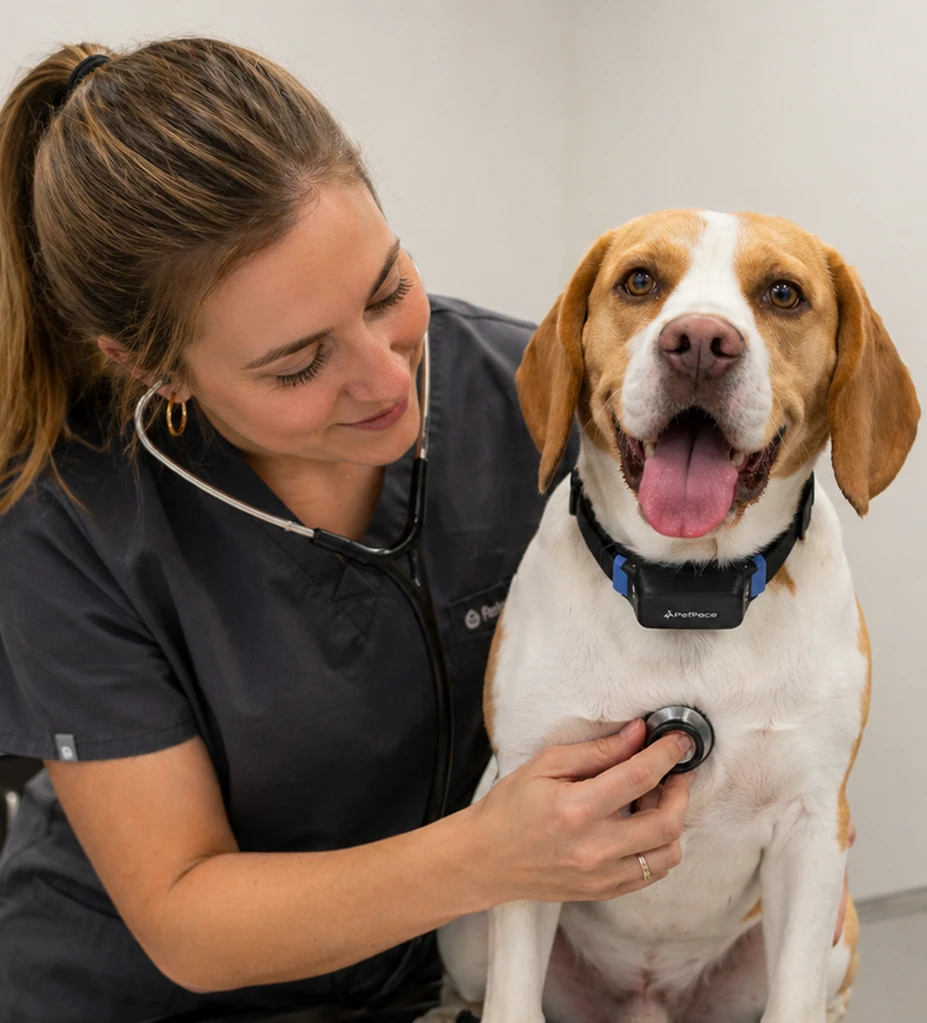
A 6-year-old Labrador trots into the clinic, tail going, and the tech counts 124 beats a minute. Her owner goes pale. Two nights later the same dog is asleep on the couch, and a hand on her ribs counts closer to 55.
Neither number is wrong. They belong to two different dogs: one braced for a stranger with a thermometer, one at rest in her own living room. This guide covers what a normal dog heart rate looks like at home, how it shifts with size, age, sleep and season, how to check it yourself, and the point where a number deserves a call to your vet.
The short answer: Most healthy adult dogs have a resting heart rate of roughly 55 to 65 beats per minute at home, with a median near 60, according to a 2025 study of 703 dogs. Clinic charts list 60 to 140 because stress and excitement push the number up. Small dogs and puppies run faster, large dogs slower.
Medically reviewed by Asaf Dagan – Co-Founder and Chief Veterinary Scientist at PetPace
What counts as a normal dog heart rate at home?
Most healthy adult dogs sit between about 55 and 65 beats per minute when they’re relaxed at home. The median in the largest home dataset published so far is 60.5.
That dataset comes from a 2025 study in Frontiers in Veterinary Science (Chetboul et al.), which followed 703 apparently healthy dogs in 29 countries for a median of about six months. The monitor only recorded when a dog was lying still, so the numbers reflect true resting physiology rather than a dog mid-zoomie.
It’s a lot lower than most charts. The ranges in clinic handouts run from 60 up to 120 or even 140, and they aren’t wrong, exactly. They’re built from exam-room readings, where a nervous or excited dog will clock a faster pulse. The clinic number tells you how your dog handles the clinic.
Two caveats the study itself flags. Health status came from an owner questionnaire rather than a vet exam, so a few dogs with early, silent disease could be hiding in the “healthy” group. And three of the four authors work for the company that makes the monitor used. The work was peer-reviewed and it’s the first large home dataset of its kind, but it’s one study, not settled law.
Heart rate by dog size: small dogs run faster, but less than you’d think
Smaller dogs do have faster hearts. At rest, though, the gap is narrower than older charts suggest. In the 2025 home data, dogs of 22 pounds or less had a median of 65 bpm, against 59.5 for dogs over 44 pounds.
| Dog size | Typical clinic reference, resting (AMC, 2025) | Home resting median (Chetboul et al., 2025) |
| Small | 90 to 120 bpm | 65.0 (dogs 22 lb / 10 kg or less) |
| Medium | 70 to 110 bpm | 62.1 (all dogs up to 44 lb / 20 kg, pooled) |
| Large | 60 to 90 bpm | 59.5 (dogs over 44 lb / 20 kg) |
An earlier clinic-based study of 10,849 dogs (Hezzell et al., 2013) found about a 10-beat difference between a 5 kg and a 55 kg dog. So the direction holds. How big the gap looks depends on where you measure.
Breed matters even less than most owners expect. In the home study, Golden Retrievers and Labradors both had a median of 57.9 bpm, German Shepherds 58.1, and Australian Shepherds ran lowest at 54.5. Dobermans, a breed owners often worry about because of dilated cardiomyopathy, landed at 60.6, which is unremarkable. Each breed had only 18 to 31 dogs, so treat these as a rough guide rather than a reference range. Your own dog’s baseline beats any breed average.
How age, sleep and season move the number
Puppies run fast, adults settle, and seniors creep back up. Sleep lowers the rate by a few beats, and so can summer.
In the home study, puppies up to 12 months had a median of 78.5 bpm. Adults aged 1 to 10 came in around 59, and dogs 10 and older rose to 68.7. That senior bump is small. It could be aging itself, or quiet conditions nobody has caught yet, and the authors say they can’t separate the two.
Time of day shows up in the data too: a median of 58.3 bpm between midnight and 6 a.m., versus 61.3 the rest of the day. Three beats won’t make a difference to a single reading, but it’s the reason a pulse counted at 9 p.m. in front of the TV and one counted at 3 a.m. won’t match.
Then there’s the calendar. In dogs living in the Northern Hemisphere, resting heart rate was lower in August, September and October than in January, while breathing rate peaked in August, which fits with dogs panting to cool off. A slightly lower pulse in late summer isn’t a red flag on its own.
Context is half of interpretation. A resting 70 bpm means one thing in a 3-year-old Border Collie, whose breed median in the study was 56.6, and another in a 12-year-old of any breed, where the senior median was 68.7.
How to check your dog’s pulse at home
Lay your hand flat on your dog’s left chest, where the elbow meets the ribs. Count beats for 15 seconds, multiply by four, and do it while your dog is calm and lying down. That’s the same spot the Animal Medical Center of New York points owners to in its pet vital signs guide.
If you can’t find the heartbeat there, try the femoral pulse on the inside of the upper thigh, near the groin. Take three or four readings over several days, in the same state each time (asleep or settled, never right after a walk, and never when the doorbell’s just rung). Write them down. The average of those readings is your dog’s baseline.
One honest warning: this is harder than it sounds. Small dogs, deep or furry chests, fast hearts and your own pulse thumping in your fingertips all lead to miscounts, and the 2025 study notes that most owners haven’t been trained to measure heart rate accurately. If your count seems unreliable, count breaths instead, which is much easier, and ask your vet to show you the best spot on your dog at the next visit.
When a heart rate number is worth a call to your vet
One odd reading usually means nothing. A rate that stays above your dog’s own baseline for days, or any change that comes with symptoms, is worth a phone call.
Don’t expect a clean cutoff. In the home study, dogs with heart disease had a median resting rate of 67.3 bpm against 60.5 in healthy dogs. The ranges overlap, which is exactly why a trend over time tells you more than any single threshold.
The study also describes one dog with degenerative mitral valve disease whose resting heart rate climbed gradually over roughly 120 days before fluid built up in the lungs. The owner hadn’t noticed. It’s a single case and doesn’t prove rate trends predict heart failure, but it shows why vets care more about direction than about one number.
Breathing is the better-established signal at home. Cardiologists commonly use 30 breaths per minute, counted while a dog is asleep or resting, as the line worth reporting. In a 2016 study of dogs and cats with medically controlled left-sided heart failure (Porciello et al.), the median sleeping rate in dogs was 20 breaths per minute, and only one dog averaged 30 or above. A separate piece on counting sleeping respiratory rate is coming [INTERNAL LINK: dog respiratory rate post, calendar #17].
Skip the counting and get to a vet right away if your dog collapses or faints, has pale or bluish gums, is struggling to breathe, or has a new cough along with fast breathing. And don’t change any medication because of a reading. That’s your vet’s call.
Where continuous monitoring fits in
A 15-second pulse check is a snapshot. The 2025 study points out that manual readings cover less than 0.1% of a day, which means they miss the night-and-day swing, the post-meal bump, and the slow drift that only shows up over weeks.
The PetPace Collar V3.0 measures pulse, respiration, temperature, heart rate variability, activity and sleep around the clock, so you can see your dog’s own pattern rather than a one-off number. The data can go straight to your vet before an appointment, which turns “she seemed fine at home” into a chart (more on sending your dog’s data to your vet). It won’t diagnose anything. A murmur, an arrhythmia or heart failure needs an exam, and Holter monitoring is still the standard for rhythm problems. What a collar adds is the long view. For more on why the clinic number and the home number differ, see vet checkups vs. real-life heart rate.
FAQ
What is a normal heart rate for a dog while sleeping?
In a 2025 study of healthy adult dogs, the median between midnight and 6 a.m. was about 58 beats per minute, roughly three beats lower than the daytime figure. Individual dogs vary, and dreaming can cause short spikes, so count over a quiet minute or two and take several readings over a few nights before you decide what’s normal for yours.
Is 120 beats per minute normal for a dog?
At the vet, for a small or excited dog, it can be. For an adult dog lying calmly at home it’s well above the typical 55 to 65. Recheck when your dog is relaxed and settled. If the rate stays high on repeat checks, or comes with coughing, tiring easily or fast breathing, call your vet.
Should a dog’s heartbeat be irregular?
A pulse that speeds up as your dog breathes in and slows as they breathe out is common in healthy dogs. A pulse that skips, stalls or feels chaotic is different. You can’t judge that by feel alone, so if you notice it, have your vet listen to the heart and decide whether more testing is needed.
How do I check my dog’s heart rate without a stethoscope?
Rest your palm on the left side of the chest, just behind the elbow, while your dog lies calmly. Count the beats for 15 seconds and multiply by four. Repeat a few times across several days and average the results. If you can’t get a steady count, track breathing rate instead, and ask your vet to show you the best spot.
Do senior dogs have a higher resting heart rate?
Slightly, on average. In the 2025 home study, dogs aged 10 and older had a median of 68.7 bpm against about 59 in adults aged 1 to 10. The authors couldn’t rule out hidden conditions behind that rise, so a senior dog’s baseline matters more than the average, and sudden changes from it are worth mentioning to your vet.
Know your dog’s baseline
Skip the chart on the fridge. Take three or four readings this week while your dog is settled or asleep, write them down, and you’ll have a baseline that’s worth more than any average in this article. The question to ask isn’t “is 62 normal?” It’s “is 62 normal for her, and has it changed?”
If you’d rather not count, the PetPace Collar V3.0 tracks resting pulse and breathing around the clock and builds that baseline for you. Whichever route you take, bring the numbers to your next vet visit.
Sources
- Chetboul V, Humbert E, Dougoud L, Lorre G (2025). Resting heart and respiratory rates in dogs in their natural environment (the AI-COLLAR study). Frontiers in Veterinary Science 12:1667355. https://doi.org/10.3389/fvets.2025.1667355
- Animal Medical Center of New York (updated Oct 2025). Vital Signs: Know What’s Normal for Your Pet. https://www.amcny.org/pet_health_library/vital-signs/
- Hezzell MJ, Humm K, Dennis SG, Agee L, Boswood A (2013). Relationships between heart rate and age, bodyweight and breed in 10,849 dogs. Journal of Small Animal Practice 54:318-324. https://doi.org/10.1111/jsap.12079
- Porciello F, Rishniw M, Ljungvall I, Ferasin L, Haggstrom J, Ohad DG (2016). Sleeping and resting respiratory rates in dogs and cats with medically-controlled left-sided congestive heart failure. The Veterinary Journal 207:164-168. https://doi.org/10.1016/j.tvjl.2015.08.017